Wellness Lighting · Ultra-Low EMF
Low EMF Lighting — the cleanest infrastructure available
A deep dive into the science, technology, and health considerations behind Colorbeam's low-voltage infrastructure.
Explore the Colorbeam wellness pillars | HCL & Circadian Lighting · Flicker-Free Dimming
What it is
EMF, low-voltage infrastructure, and why it matters for your home
Electromagnetic fields — EMF — are invisible areas of energy that surround electrical devices and wiring. Every home has them. The question isn't whether they exist, but how much exposure the people living in that home have, and whether that exposure can be meaningfully reduced. Conventional residential lighting runs on 120V high-voltage Romex wiring from the electrical panel to every fixture in the home — distributing high-voltage infrastructure, and the EMF it generates, throughout every wall, ceiling, and floor of the building.
The scientific and regulatory landscape on EMF is evolving. The International Agency for Research on Cancer — the WHO's cancer research arm — classifies extremely low frequency magnetic fields from electrical wiring as a Group 2B possible human carcinogen, based on research linking prolonged exposure to elevated levels with increased risk of childhood leukemia. Multiple national health agencies including those in Canada, France, and the UK have adopted prudent avoidance policies recommending that EMF exposure be minimized where possible.
Colorbeam doesn't make medical claims about EMF. What it does do is offer the only architectural lighting system built on a low-voltage infrastructure that measurably and demonstrably reduces the electromagnetic field contribution of the lighting circuit throughout the home. For homeowners who have invested in non-toxic building materials, air filtration, and water quality — this is the lighting system that belongs in that home.
Colorbeam's answer isn't a shielding product or a retrofitted fix. It's an infrastructure decision made at the most fundamental level — a system that never generates the problem in the first place. That's a meaningfully different approach, and it's the only one that works at the architectural scale a custom home demands.
The Technology
How Colorbeam's infrastructure works — and why it's different
The EMF reduction benefit isn't achieved through a filter, a shield, or a special component added to a conventional system. It's a direct consequence of the infrastructure itself. Understanding why requires understanding how conventional lighting wiring works — and what Colorbeam does differently at the most fundamental level.
Layer 01 · The Problem
120V high-voltage — distributed to every fixture
In a conventionally wired home, high voltage travels from the electrical panel through Romex cable to every single switch, dimmer, and fixture in the building. This means high-voltage wiring runs through every wall and ceiling — and with it, the electromagnetic fields that high-voltage alternating current generates. These fields radiate outward from the wiring and are present at measurable levels throughout the living space, regardless of whether the lights are on or off.
The level of EMF generated depends on the voltage, the current draw, and the proximity of the wiring to occupied spaces. In a typical home, the lighting circuit runs directly above ceilings and inside walls where people spend the majority of their time — often within a few feet of where they sleep, work, and live.
Layer 02 · The Solution
48V low voltage over CAT6 —
high voltage stops at the rack
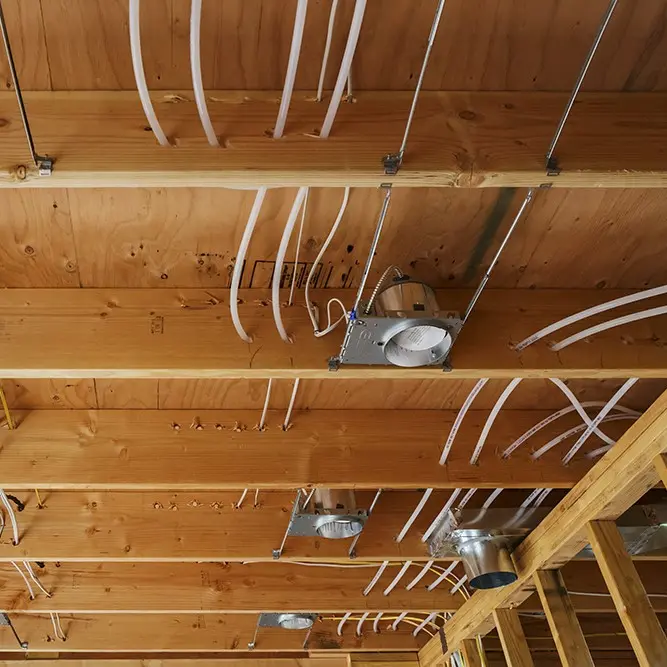
Colorbeam's system works differently at the infrastructure level. High voltage enters the system once — at the central distribution point, either a rackmount unit for downlight fixtures or a DIN rail unit for tape lighting. From that point forward, everything traveling to the fixtures runs at 48 volts over CAT6 network cable — the same type of cable used for your home network — or 24V over multi-conductor wire for tape light. One cable serves up to four fixtures. No high-voltage wiring beyond the distribution point, mitigating EMF throughout your walls and ceilings.
The result is the lowest measurable EMF readings in the architectural lighting industry. Not as a claimed benefit, but as a measurable, verifiable consequence of how the system is built.
Layer 03 · Industry Validation
Trusted by building biologists and healthy home specifiers
Colorbeam is the preferred lighting system of SENERGY360, one of North America's leading healthy home design firms, and its founder Brian Johnson — a certified building biologist who has made reducing EMF exposure a core principle of every project his firm undertakes. Building biologists are among the most rigorous evaluators of EMF in the residential environment. Their endorsement of Colorbeam's low-voltage infrastructure is not a marketing relationship — it's a technical validation by people whose professional practice is built on exactly this standard.
For architects, designers, and builders working with health-conscious clients, Colorbeam's infrastructure provides a verifiable, specifiable answer to the EMF question — one that can be communicated clearly and backed by measurable data.
— Brian Johnson, Building Biologist · SENERGY360

Health Considerations
What the research says — and how to think about it
EMF is a topic where the science is real, the research is ongoing, and the conclusions are still evolving. The following is an honest summary of where the evidence stands — without overstating what is known or understating what is a legitimate area of health concern.
Research & Sources
The research behind this page
The following sources informed the content on this page. Each includes a plain-language summary and a direct link to the full resource.
Ready to go further
Build a cleaner home environment from the group up
Colorbeam's low-voltage infrastructure is specified at the design stage — the earlier it's considered, the more it can do.